

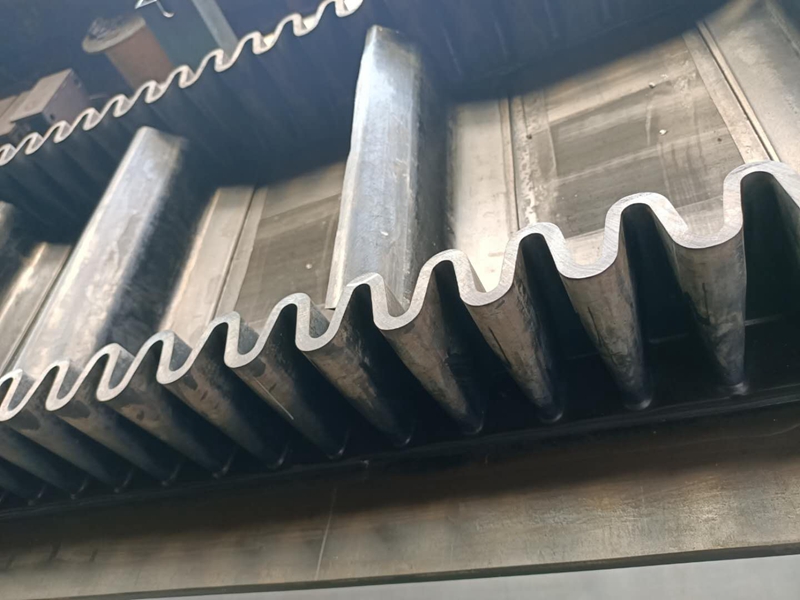
Introduction and Technical Parameters of Large Tilt Angle Conveyor Belt Products
1、 Product Core Introduction
The large angle conveyor belt is a special conveyor belt designed specifically to solve the problem of "large angle material conveying". It breaks through the traditional flat belt ≤ 18 ° and ordinary edge belt ≤ 30 ° conveying restrictions, and can achieve 30 ° -90 ° (vertical) material conveying. It combines the three core advantages of "high conveying efficiency, small footprint, and energy saving and consumption reduction", and widely replaces traditional bucket elevators and scraper conveyors. It is suitable for continuous conveying of bulk, granular, block, and partially viscous materials.
1. Core Features
Strong inclination adaptability: Designed with a three in one structure of "base band+edge+transverse partition", the edge height can be selected from 50-630mm, and the spacing between transverse partitions can be customized according to needs, which can stably transport materials without leakage or slipping. The vertical conveying height can reach over 30m.
Wear resistant and tear resistant: The base tape is made of high-strength polyester canvas (EP) or nylon canvas (NN) as the skeleton, and the surface is covered with wear-resistant rubber (natural rubber+styrene butadiene rubber blend). The wear resistance is 40% higher than that of ordinary conveyor belts, and the tear resistance strength is ≥ 25kN/m. It is suitable for strong abrasion resistant materials such as ores and coal.
Low energy consumption design: The running resistance of the conveyor belt is small (friction coefficient ≤ 0.03). Compared with bucket elevators with the same conveying capacity, the energy consumption is reduced by 20% -30%, and the continuous conveying is uninterrupted. The hourly conveying capacity of a single machine can reach 10-5000m3.
Strong adaptability: can customize special models that are resistant to high and low temperatures (-40 ℃ -120 ℃), acid and alkali (pH value 2-12), flame retardant and anti-static, etc., to meet the harsh working conditions of different industries such as mining, chemical, power, and grain.
2. Applicable scenarios
Mining industry: transporting block/granular materials such as coal, iron ore, limestone, tailings, etc., such as underground mining area transportation and ground crushing station transportation.
Power industry: Coal transportation and fly ash transportation in power plants to avoid dust pollution.
Chemical industry: Transport corrosive materials such as fertilizer particles, soda ash, salts, etc. (choose acid and alkali resistant models).
Grain industry: Transporting loose grains such as wheat, corn, soybeans, etc., vertically lifting them into silos for storage.
Construction industry: transporting sand and gravel, cement clinker, construction waste, etc. to reduce site occupation.
2、 General Technical Parameters
The following are the core technical parameters of high angle conveyor belts (including edge belts and wavy edge belts), which can be customized and adjusted according to customer working conditions:
|
parameter category |
Parameter range/standard value |
Instructions |
|
Basic structural parameters |
|
|
|
Type of conveyor belt |
Wave shaped edge conveyor belt (mainstream), skirt edge conveyor belt |
The wavy edge band is suitable for a larger inclination angle (≤ 90 °), and the skirt band is ≤ 45 ° |
|
Edge height (H) |
50mm、80mm、120mm、160mm、200mm、240mm、300mm、400mm、630mm |
The higher the height, the greater the single conveying capacity, and it is necessary to match the material particle size |
|
Horizontal partition type |
T 型、C 型、TC 型、TS 型 |
T-type is suitable for fine particles, TC/TS type is suitable for large materials (particle size ≤ H-20mm) |
|
Horizontal partition spacing (P) |
200mm、300mm、400mm、500mm、600mm |
The smaller the spacing, the better the material stability, usually P=2-3 times the height of the retaining edge |
|
Baseband width (B) |
500mm、650mm、800mm、1000mm、1200mm、1400mm、1600mm、1800mm、2000mm |
Conventional width ≤ 2000mm, can be customized with wider specifications |
|
performance parameters |
|
|
|
Applicable inclination angle |
30 ° -90 ° (vertical) |
Conventional recommendation is 30 ° -60 °, and vertical conveying requires a guiding device |
|
conveying speed |
0.8-3.15m/s |
Suggested particle material speed ≤ 2.5m/s to avoid material spillage |
|
Rated tension |
16-315kN/m |
Divided by skeleton material: EP100, EP200... EP315 |
|
Surface rubber thickness |
Upper cover adhesive 3-15mm, lower cover adhesive 2-6mm |
Choose adhesive with a thickness of ≥ 8mm for materials with strong wear and tear (such as ore) |
|
Temperature resistance range |
Ordinary type -15 ℃ -80 ℃; High and low temperature resistant -40 ℃ -120 ℃ |
Special working conditions can be customized to withstand high temperatures up to 150 ℃ |
|
Flame retardant rating |
Compliant with GB/T 10822-2021 "General purpose fabric core flame retardant conveyor belts" |
Coal mines underground must meet the MT/T 113-2019 standard |
|
Material Parameters |
|
|
|
Baseband skeleton |
Polyester canvas (EP), nylon canvas (NN), steel wire rope core (ST) |
Wire rope core type is suitable for high tension and long-distance transportation |
|
Edge/bulkhead material |
Natural rubber (NR)+styrene butadiene rubber (SBR) blend |
Good elasticity, aging resistance, and a service life of ≥ 3 years |
|
Covering adhesive Shore hardness |
60±5 Shore A |
Balance wear resistance and elasticity to avoid material adhesion |
Remarks
1. The above parameters are universal standards, and actual products need to be customized according to "material characteristics (particle size, humidity, density), conveying capacity, lifting height, and working environment";
When transporting over long distances (>100m) or under high tension, it is recommended to use a steel wire rope core (ST) skeleton to reduce the stretching deformation of the conveyor belt;
3. Corrosive materials (such as acidic and alkaline solutions, salt spray) should be covered with chloroprene rubber (CR) or nitrile rubber (NBR) to enhance their corrosion resistance.