

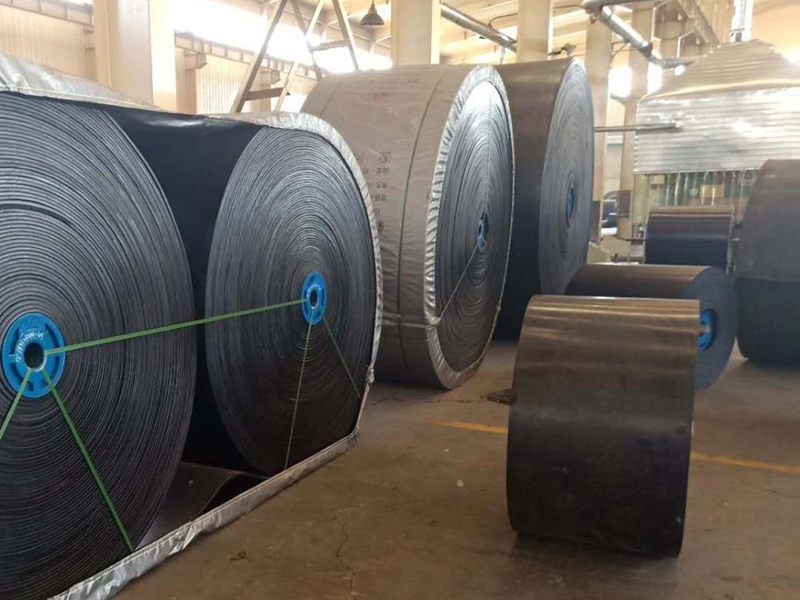
High Temperature Resistant Belt Product Introduction and Technical Parameters
1. Product Core Introduction
High temperature resistant belts are specially designed for high temperature working conditions of -40℃-300℃ (some special models can reach 500℃). Through special material formula and structural optimization, it solves the problems of traditional belts being easily aged, cracked, and strength attenuated in high temperature environments. It has four core advantages: "high temperature resistance, anti-aging, wear and tear resistance, and safety and stability". It is widely used in continuous transportation scenarios of high temperature materials in metallurgy, building materials, chemical industry, electricity and other industries.
1. Core Characteristics
Super strong temperature resistance performance: According to the temperature resistance level, it is divided into medium temperature type (120℃-200℃), high temperature type (200℃-300℃), and ultra-high temperature type (300℃-500℃). Different models adopt the corresponding high temperature resistant materials (such as EPDM rubber, nitrile rubber, fluororubber, etc.). It can operate continuously at the rated temperature without softening or deformation, and the service life is 2-3 times longer than ordinary belts.
Enhanced wear and tear resistance: The base belt skeleton is made of high-strength polyester canvas (EP), nylon canvas (NN), or steel wire rope core (ST). The surface is covered with high wear-resistant and high temperature resistant rubber, with a tear resistance of ≥30kN/m, and the wear resistance is 50% higher than ordinary high temperature belts. It is suitable for high temperature block materials such as coke, sintered ore, and cement clinker.
Safety protection design: Built-in flame retardant and anti-static agent, in accordance with GB/T 10822-2021 "General Purpose Textile Core Flame Retardant Belt" standard, it can meet the anti-static flame retardant requirements of MT/T 113-2019 in coal mines or explosive scenes, avoiding safety hazards caused by high temperature materials; some models add anti-adhesion coating to reduce the blockage of the conveyor caused by the adhesion of high temperature materials.
Strong environmental adaptability: In addition to high temperature resistance, it can also be equipped with acid and alkali resistance (pH value 1-14), oil resistance, ozone resistance, etc. at the same time, to adapt to complex working conditions such as acidic high temperature flue gas in metallurgy industry and high temperature corrosive materials in chemical industry; it still maintains good elasticity in low temperature environment (-40℃), avoiding low temperature brittleness.
2. Application Scenarios
Metallurgical industry: Conveying sintered ore (180℃-250℃), coke (200℃-280℃), steel slag (250℃-300℃), such as the transfer of finished products in the sintering plant and the delivery of furnace materials in the steel plant.
Building materials industry: Conveying cement clinker (180℃-220℃), lime (150℃-200℃), suitable for the finished product conveying system of cement production line and lime kiln.
Chemical industry: Conveying high-temperature resin (120℃-180℃), molten salt (200℃-300℃), high-temperature catalyst (220℃-280℃), need to be matched with acid and alkali resistant models.
Electric power industry: Conveying high-temperature fly ash (100℃-150℃), boiler slag (200℃-250℃), suitable for the slag removal system of power plants.
Waste treatment industry: Conveying high-temperature furnace slag after waste incineration (250℃-300℃), need to have flame retardant and corrosion resistance characteristics.
Second, general technical parameters
The following are the core technical parameters of high-temperature resistant conveyor belts (including fabric core, steel wire rope core series), which can be customized and adjusted according to the customer's high-temperature working conditions and material characteristics:
|
Parameter category |
Parameter range / standard value |
Explanation |
|
Basic structural parameters |
|
|
|
Conveyor belt type |
High temperature resistant conveyor belts with fabric core (EP/NN series), high temperature resistant conveyor belts with steel cord core (ST series) |
Fabric core is suitable for medium and short distances, medium and low tension; steel wire rope core is suitable for long distances, large tension. |
|
Baseband width (B) |
500mm; 650mm; 800mm; 1000mm; 1200mm; 1400mm; 1600mm; 1800mm; 2000mm; 2200mm |
Regular width ≤ 2200mm, custom made for extra wide specifications (≥ 2400mm) |
|
Covering rubber type |
EPDM, NBR, FKM, CR |
EPDM temperature range: 120℃-200℃; NBR temperature range: 150℃-250℃; FKM temperature range: 300℃-500℃ |
|
Covering rubber thickness |
Top cover rubber 4-20mm, bottom cover rubber 3-10mm |
High temperature and strong wear materials (such as steel slag) selected glue ≥10mm |
|
Performance parameters |
|
|
|
Rated temperature range |
Medium temperature 120℃-200℃; High temperature 200℃-300℃; Ultra high temperature 300℃-500℃ |
Short-term peak temperatures can exceed the rated value by 10%-20% (lasting ≤30 minutes) |
|
Delivery speed |
0.8-4.0m/s |
High temperature block material is recommended to be ≤3.0m/s, avoid material impact damage the conveyor belt. |
|
Rated tension |
Fabric core 16-315kN/m; steel wire rope core 200-630kN/m |
The steel wire rope core model is divided according to ST630, ST800...ST4000, suitable for different tension requirements. |
|
Tear resistance |
Fabric core ≥30kN/m; steel wire rope core ≥80kN/m |
Ultra-high temperature type (FKM material) tear resistance can be increased to ≥40kN/m |
|
Flame retardant grade |
Meet GB/T 10822-2021 Flame retardant grade 1; meet MT/T 113-2019 Anti-static flame retardant requirements in coal mine scene |
Oxygen index ≥ 32%; vertical burning time ≤ 30 seconds |
|
Acid and alkali resistance |
pH value 1-14 (Acid and alkali resistant type) |
After 24 hours of soaking, the tensile strength retention rate ≥ 80%, hardness change ≤ 10 Shore A |
|
Material parameters |
|
|
|
Baseband skeleton |
Polyester canvas (EP100-EP315), nylon canvas (NN100-NN315), steel wire rope (ST630-ST4000) |
The steel wire core is treated with galvanization or copper plating to enhance high-temperature corrosion resistance. |
|
Covering rubber Shores hardness |
65±5 Shore A (moderate to high temperature type); 70±5 Shore A (ultra high temperature type) |
Balance high temperature resistance with wear resistance, avoiding excessive hardness decay at high temperatures. |
|
Aging performance |
After 150℃×168 hours aging, the tensile strength retention rate ≥70%, the elongation retention rate ≥60%. |
High temperature resistance (FKM material) aging retention rate can be improved to ≥80%. |
Notes
1. Actual selection requires providing key information such as "material temperature (long-term / peak), material particle size and hardness, conveying capacity, conveying distance, working environment (whether it contains acid and alkali / oil pollution)", to avoid damage due to improper selection;
2. For ultra-high temperature (≥300℃) conditions, it is recommended to match high-temperature resistant idlers (such as ceramic idlers, stainless steel idlers) and high-temperature resistant conveyor belt joints (using vulcanized joints or metal buckle joints) to ensure the overall system's temperature resistance;
3. When the conveying temperature exceeds 300℃ for a long time, it is necessary to customize special structures (such as built-in cooling layers), and specific plans can be communicated with the manufacturer's technical team.