

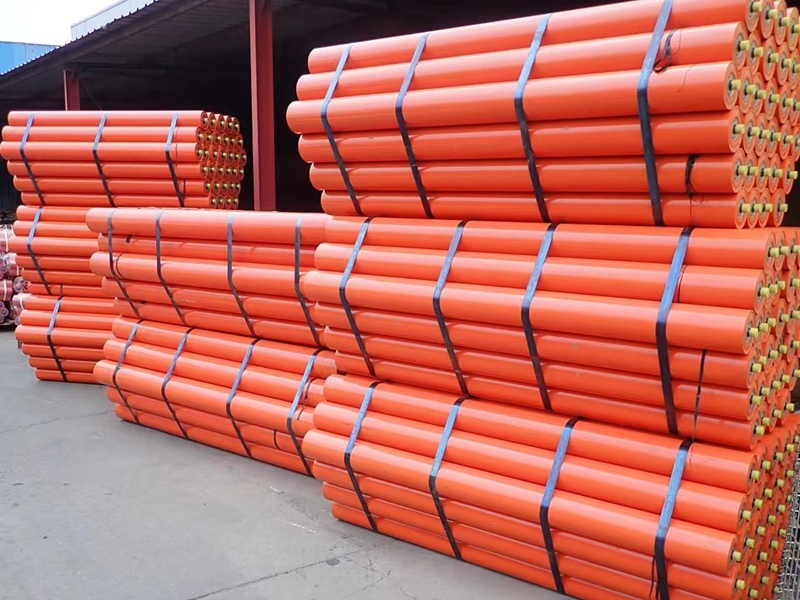
Conveyor Idler Product Introduction and Technical Parameters
1. Product Core Introduction
Conveyor idlers are the core supporting components of belt conveyors. Their main functions are to bear the weight of the conveying belt and the materials, reduce the friction resistance of the conveying belt during operation, and ensure the stable operation of the conveying belt. Through the structural design of "high-precision bearings + wear-resistant roller bodies + sealing protection", the goal of "low resistance, high wear resistance, long service life, and low maintenance" is achieved. They are widely used in belt conveyor systems in mining, coal, building materials, ports, grain, and other industries. They are key components to ensure the stable operation of the conveyor.
1. Core Features
Low resistance and efficient operation: High-precision deep groove ball bearings (such as 6205, 6306 models) are used, with the bearing radial clearance controlled at 0.015-0.025mm. Matching with special lubricating grease (high temperature type uses lithium-based lubricating grease, low temperature type uses synthetic lubricating grease), the idler rotation resistance coefficient ≤ 0.02, which is 15%-20% lower than ordinary idlers, can reduce the load of the conveyor motor and lower the operation cost.
Strong wear resistance and impact resistance: The roller body material is designed according to the working condition classification. For ordinary working conditions, Q235 cold-rolled steel plate (wall thickness 3-5mm) is selected. For wear-resistant working conditions, wear-resistant ceramics (alumina content ≥ 92%), high molecular weight polyethylene (molecular weight ≥ 3 million) or galvanized/chromium-plated steel plates are selected. Among them, the surface hardness of the ceramic idler ≥ HRA85, the wear life is 3-5 times higher than ordinary steel idlers, and it can withstand the impact of a single material ≤ 300kg, which is suitable for the transportation of strong wear-resistant materials such as mine ore and coal.
Strong sealing protection: The "double seal + dust cover" structure is used, with nitrile rubber skeleton oil seals on the inner side (resistant to oil, temperature range -30℃-120℃) and a maze-type dust seal on the outer side. The protection grade can reach IP65, which can effectively block dust, water vapor, and material particles from entering the bearing. In harsh environments such as high dust concentration in mines and damp ports, the bearing service life can still reach more than 20,000 hours, reducing the frequency of maintenance.
Adapt to a variety of scenario needs: Different specifications can be customized according to the type of conveyor (slot type, parallel, buffer) and working environment (high and low temperature, corrosion, explosion-proof). For example, explosion-proof idlers for underground mines (complying with Ex d I Mb standard), corrosion-resistant stainless steel idlers (304/316 material) for the chemical industry, and food-grade high molecular idlers for the grain industry, which meet the special requirements of different industries.
Easy to install and maintain: The two ends of the idler shaft adopt a standardized shaft head design (such as round, square, flat), which can be quickly assembled with the idler bracket of the conveyor frame without additional processing; some models use "maintenance-free bearings", which are filled with long-lasting lubricating grease before leaving the factory, and there is no need to replenish grease frequently during use, reducing maintenance costs by 40%.
2. Application scenarios
Mining / Coal industry: Slot idlers, buffer idlers are used for underground / ground belt conveyors, supporting bulk materials such as ore, coal, etc., ceramic idlers or wear-resistant steel idlers can cope with strong wear, and explosion-proof idlers are suitable for underground flammable and explosive environment.
Building materials industry: Parallel idlers, self-centering idlers are used for cement, sand and stone conveyor, stainless steel idlers can avoid cement dust adhesion, and reduce the risk of conveyor belt deviation.
Port / Logistics industry: Heavy-duty idlers (load ≥ 5kN / support) are used for coal and ore transfer conveyors at bulk cargo ports, high molecular idlers can reduce self-weight, and reduce the load of the conveyor frame.
Grain / Food industry: Food-grade high molecular idlers (complying with FDA standard) are used for grain and flour conveyor, avoiding metal contamination, and the surface is smooth and non-adhesive.
Chemical industry: Corrosion-resistant idlers (304 stainless steel, glass fiber reinforced plastic material) are used for acid and alkali material conveyors, preventing the roller body from being corroded and damaged, and suitable for fertilizer, pure alkali and other material conveyors.
II. General technical parameters
The following are the core technical parameters of the conveyor idler (including slot type, parallel, buffer, self-centering, etc.), which can be customized and adjusted according to the specifications of the conveyor and the working conditions:
|
Parameter category |
Parameter range / standard value |
Explanation |
|
Basic structural parameters |
|
|
|
Type of idler |
idler (30°/35°/45° idler angle), parallel idler, buffer idler, self-c Centring idler (friction type / vertical roller type), return idler |
槽型 idler is used for the carrying section (conveying the material); parallel idler is used for the return section (conveying the empty belt); buffer idler is used for the feed section (to reduce the impact of the material). |
|
Roller diameter (D) |
63mm, 76mm, 89mm, 108mm, 133mm, 159mm, 194mm, 219mm |
The larger the diameter, the greater the load-bearing capacity, and long-distance / high-flow conveyors are recommended to use ≥133mm diameter idlers. |
|
Roll length (L) |
200mm; 300mm; 400mm; 500mm; 600mm; 700mm; 800mm; 900mm; 1000mm |
The length needs to match the width of the conveyor belt, the length of the troughed idler is usually 50-100mm smaller than the width of the conveyor belt, to avoid the roller body exceeding the edge of the conveyor belt. |
|
Rolling mill material |
Q235 steel, wear-resistant ceramic (Al₂O₃≥92%), high molecular weight polyethylene (molecular weight 3-5 million), 304/316 stainless steel, glass fiber reinforced plastic. |
Ordinary working condition select Q235 steel; Strong wear select ceramic / polymer; Corrosive working condition select stainless steel / glass fiber reinforced plastic |
|
Bearing model number |
Deep groove ball bearings: 6204, 6205, 6206, 6305, 6306, 6307 |
Bearing load ≤ 3kN, select 62 series; bearing load ≥ 5kN, select 63 series, bearing accuracy grade ≥ P6 grade. |
|
Performance parameters |
|
|
|
Rated capacity |
Single idler: 1kN-15kN (adjust according to diameter / material) |
The load capacity of the slot type idler is calculated as 3 pieces per group, the total load capacity ≥ 1.2 times the total load of the conveyor. |
|
Rotating drag coefficient |
≤0.02 (empty); ≤0.03 (full) |
The lower the drag coefficient, the smaller the energy consumption of the conveyor, and the test standard meets GB/T 13792-2021. |
|
Maximum speed |
800r/min (steel idler); 600r/min (ceramic idler); 500r/min (polymer idler). |
The speed must be matched to the belt speed to avoid overspeed causing bearing overheating damage (speed = belt speed × 1000/(π × roller diameter)). |
|
Temperature range |
Ordinary type: -20℃-80℃; Low temperature type: -40℃-60℃ (low temperature grease optional); High temperature type: -10℃-120℃ (high temperature grease optional) |
Special materials (such as high-temperature ceramics, low-temperature rubber seals) need to be customized for temperatures outside the range. |
|
Protection level |
IP65 (Ordinary Sealing); IP66 (Enhanced Sealing, Suitable for Moist / Dusty Environment) |
In mines, ports and other harsh environments, it is recommended to choose IP66 protection. |
|
Service life |
Steel idler: 10000-15000 hours; Ceramic idler: 25000-30000 hours; High molecular idler: 20000-25000 hours |
Service life is based on 16 hours of operation per day, actual life is affected by the degree of wear and tear on the conditions |
|
Special working condition parameters |
|
|
|
Explosion-proof grade (underground type) |
Ex d I Mb (coal mines); Ex d IIB T4 Ga (metal mines) |
The underground support roller must be explosion-proof certified, and bearings and seals are all made of explosion-proof materials. |
|
Corrosion resistance (stainless steel idler) |
Neutral Salt Spray Test ≥48 hours without rust (304 stainless steel), ≥100 hours without rust (316 stainless steel) |
Chemical industry, coastal ports and other corrosive environments need to confirm the grade of salt spray test. |
|
Food-grade certification (high molecular weight conveyor belt) |
Meet the standards of FDA 21 CFR Part 177.1520 and EU 10/2011 |
The food industry needs to provide food-grade certification documents to avoid material pollution. |
Note
1. Please provide the "type of conveyor (s托rengthened / flat), belt width / speed, material characteristics (particle size / hardness / corrosiveness), working environment (temperature / humidity / dust)", to ensure that the specifications of the idler match the conveyor;
2. The receiving section (where the material drops) must use a buffer idler, and the surface of the roller must be wrapped with a rubber / polyurethane buffer layer (thickness 5-10mm) to reduce the damage to the belt and idler caused by the impact of the material;
3. After long-term operation, it is necessary to regularly (every 3-6 months) check the flexibility of the idler rotation, and if there is any jamming or abnormal noise, it is necessary to replace it in time to avoid wear or deviation of the belt due to the failure of the idler.