
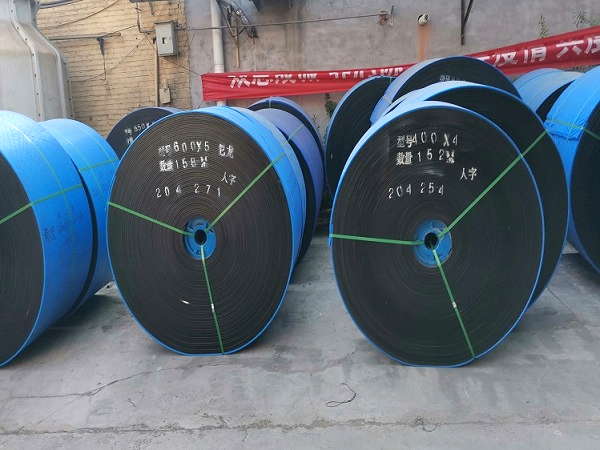
A conveyor belt, also known as a conveyor belt, is a rubber fiber or metal composite product used in belt conveyors to carry and transport materials, or a plastic fabric composite product. Belt conveyors are widely used in agriculture, industrial and mining enterprises, and transportation industries to transport various solid block and powder materials or finished items. They can be transported continuously, efficiently, and at large angles, with safe operation, easy use, easy maintenance, low freight costs, and can shorten transportation distances, reduce project costs, and save manpower and material resources.
There are many types of conveyor belts, classified according to their uses: general-purpose conveyor belts, flame-retardant and anti-static conveyor belts, general flame-retardant conveyor belts, heat-resistant conveyor belts, high-temperature resistant conveyor belts, acid alkali resistant conveyor belts, oil resistant conveyor belts, cold resistant conveyor belts, etc.
According to the classification of structural materials, there are ordinary cotton canvas conveyor belts, nylon conveyor belts, polyester conveyor belts, steel wire rope core conveyor belts, PVC core conveyor belts, PVG core conveyor belts, steel cable conveyor belts, etc.
According to product structure classification, there are: layered conveyor belt, whole core conveyor belt, steel wire rope core conveyor belt, steel cable conveyor belt, tubular conveyor belt, patterned conveyor belt, edge blocking conveyor belt, reduced layer conveyor belt, etc.
For the sake of convenience, we generally use a unified representation method to represent various conveyor belts and the representation methods for various categories of conveyor belts
1. Common representation methods for layered conveyor belts (the standard representation method is different from this, please refer to the provisions of standard GB7984 for details):
Taking NN2001000 × 6 (6+3) as an example, NN200 represents the nylon 200 type, 1000- represents the width of the belt, 6- represents the number of layers of nylon cloth, and (6+3) - represents that the upper and lower covers of the conveyor belt are 6 millimeters and 3 millimeters thick, respectively.
2. Common representation methods for steel wire rope core conveyor belts:
With ST1000H1000? Taking 4.0-6.0-6.0 as an example:
ST1000- represents the strength specification, which is 1000N/mm
H - represents the performance level of the covering adhesive
1000- represents the width of the product, in millimeters
4.0- represents the diameter of the steel wire rope, measured in millimeters
6.0-6.0- represents the thickness of the upper and lower covering adhesive, in millimeters
3. Representation method of whole core conveyor belt
Generally, PVC and PVG whole core flame-retardant conveyor belts used in coal mines are represented by strength levels and belt widths. The intensity levels are generally divided into 4, 5, 6, 7, 8, 9, 10, 11, and 16 bands, corresponding to intensities of 680 S、800S、1000S、1250S、1400S、1600S、1800S、2000S、2240S、2500s、2800S、3100S The width of the conveyor belt is generally 500mm, 650mm, 800mm, 1000mm, 1200mm, 1400mm, 1600mm, 1800mm, etc.
According to Chinese regulations, all conveyor belt products used underground in coal mines are flame-retardant and anti-static conveyor belts that comply with relevant Chinese standards. The commonly used conveyor belts in coal mining enterprises now include PVC whole core flame-retardant and anti-static conveyor belts, PVG whole core flame-retardant and anti-static conveyor belts, and steel wire rope core flame-retardant and anti-static conveyor belts.
The flame retardant and anti-static conveyor belt mainly specifies the safety performance of the product: 1. Combustion of alcohol spray lamp; 2. Surface resistance; 3. Drum friction; 4. Simulate propane combustion in tunnels. These inspection items characterize the safety performance of the product.